Edition 8: The Eight-Step Guest Journey: Where Fixed Ops Revenue Actually Leaks.
Every RO that comes through your service drive travels through the same eight steps, whether anyone's tracking them or not. From the appointment that gets set to the follow-up call weeks later, revenue either survives that trip intact or leaks out somewhere along the way.
Most departments only watch two or three of those steps closely, usually the ones tied to whatever number got flagged last month. The elite ones treat all eight as one connected system, because the guest doesn't experience your department in silos. They experience the whole trip. One weak link is enough to lose them, even when the other seven went perfectly.
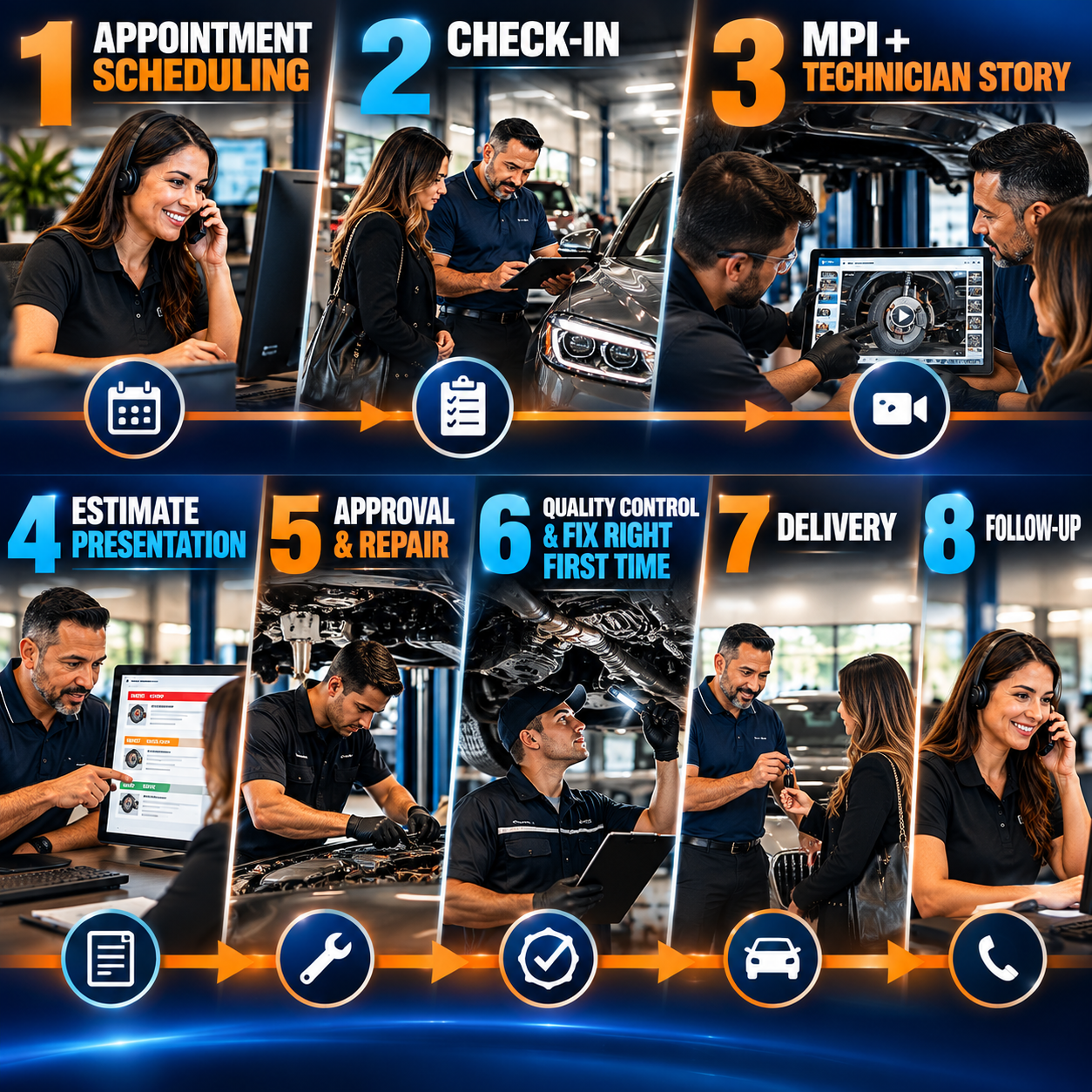
Here's the journey, step by step, and where it actually breaks.
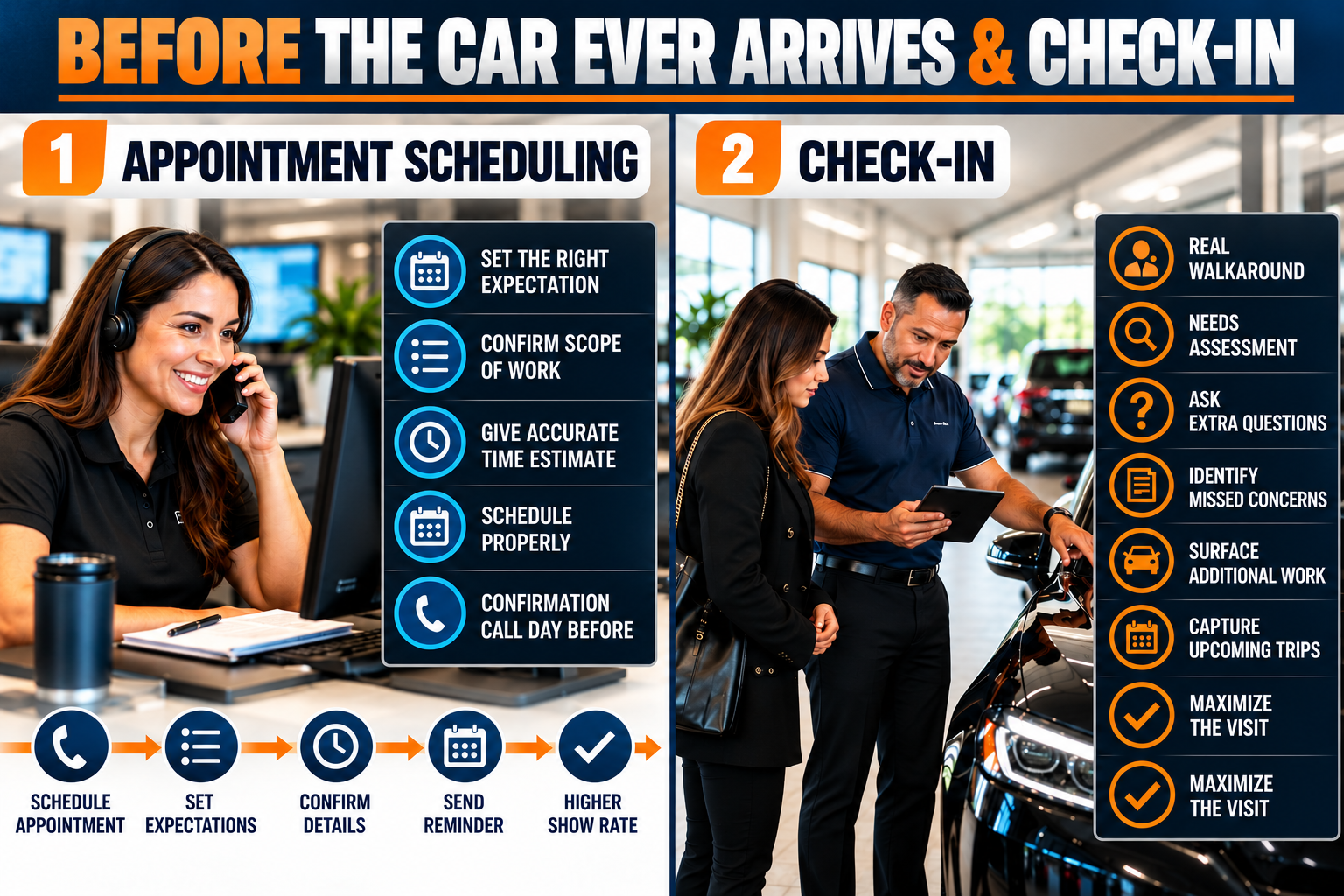
Before the Car Ever Arrives & Check-In
1. Appointment Scheduling. The RO can leak before the car ever shows up. Set the wrong expectation on the phone, wrong time estimate, wrong scope, no confirmation call, and you've built a no-show before the guest even hangs up. This is where Show Rate gets decided, days in advance, not the morning of. A confirmation call the day before does more for that number than anything anyone does the day of the appointment.
2. Check-In. A real walkaround and needs assessment surfaces the concerns a guest didn't think to mention on the phone, a noise, a warning light, a trip coming up. Skip straight to "we'll call you when it's ready" and you've closed the door on everything the visit could have uncovered before a single tech ever touches the car. The advisor who asks two extra questions at the drop-off curb is often finding work that a rushed check-in would have missed entirely.
While the Car's in the Shop
3. MPI + Technician Story. This is the moment the entire visit's revenue potential gets set. A completed inspection with no photos, no video, and no narration is a checkbox, not a sales tool. This is also where MPI View Rate starts, a guest who never opens what was sent can't act on it, no matter how thorough the tech was.
4. Estimate Presentation. Transparent and prioritized beats long and undifferentiated. A guest looking at ten items with no ranking defaults to "let me think about it." A guest looking at three tiers, needs now, needs soon, worth watching, can actually make a decision on the spot.
5. Approval & Repair. This step lives or dies on everything that came before it. A guest who saw clear proof in step 3 and a clear priority order in step 4 approves faster and questions less. A guest who got neither is negotiating from suspicion instead of understanding.
6. Quality Control (FRFT Check). Fixing it right the first time is the step guests never see and never stop noticing. A comeback doesn't just cost a redo, it quietly erases the trust built in every step before it. This is the one place where a single miss can undo the other seven steps at once.

After the Car Leaves
7. Delivery. The advisor review and future-recommendation conversation is where a one-time repair either becomes a relationship or doesn't. Rushing the handoff to get to the next car in line saves two minutes and costs a second visit. This is also the moment to set up the next visit before the guest leaves the lot, mentioning the next service interval or the item that was deferred, while the whole experience is still fresh, lands very differently than a cold call weeks later.
8. Follow-Up. The 48-hour check-in and the deferred, work campaign are the only two steps that happen after the guest has already left, which is exactly why they're the easiest to skip and the most expensive as well. A declined recommendation that never gets a follow-up call isn't closed. It's just unfinished.
Finding Your Weak Link
Most departments already have the data to find their weak link. They just have it scattered across eight different reports instead of laid out as one funnel.
Try this instead: pull each step as a single number for the same group of ROs over a set period, and lay them side by side like a conversion funnel, appointments set, appointments shown, MPIs completed, MPIs opened, estimates presented, estimates approved, FRFT rate, and deferred items followed up within your target window. Most departments will see a gradual, expected decline from step to step. Somewhere in that line, one number will drop sharply instead of gradually, a bigger fall than the step before or after it. That's the weak link, and it's usually not the step everyone assumed.
A department convinced its problem is "advisors aren't selling enough" often finds, once the funnel is laid out this way, that the real cliff is two steps earlier, an MPI view rate so low that advisors are trying to sell off proof the guest never actually saw. Fixing the advisor's pitch does nothing for a problem that started at step 3.
This is also why fixing steps in isolation rarely produces the lift a leader expects. Improving estimate presentation (step 4) when the real cliff is at check-in (step 2) is polishing a link that was never broken while the actual leak keeps leaking. The funnel view is what tells you which link to spend your limited attention on first, instead of guessing based on whichever number got mentioned in the last meeting.
One Weak Link Breaks the Whole Chain
None of these eight steps generates revenue on its own. They generate revenue as a sequence, and a guest only has to hit one broken link to walk away unconvinced, or worse, not walk back in at all.
This is why department-wide scorecards that isolate a single metric, CSI in one column, FRFT in another, show rate somewhere else, can miss the actual story. A store can look fine on any one number and still be leaking revenue at a step nobody's watching, because the guest experienced all eight steps as a single trip, not eight separate departments grading themselves.
The departments that get this right build their tracking the same way the guest actually experiences the visit: appointment through follow-up, one connected chain, with a clear owner and a clear number at every link. The ones that don't tend to optimize whichever step got attention last quarter, while the guest quietly notices the ones that didn't.
If you're an advisor or technician, this is why your piece of the chain matters even when you can't see the steps before or after yours, the guest experiences all eight as one trip, and your link is the one you control. If you're a fixed ops director or GM building out a KPI Command Center, this is the map worth checking your dashboard against: eight steps, eight owners, eight numbers.
If any one of them is a mystery, that's the step where revenue is leaking right now. See you on the next one.
-Steve