Every dealership tracks its cars closely, where they are, how long they've been there, what's holding them up. Parts inventory rarely gets the same scrutiny, even though it's the same basic problem: money sitting somewhere, quietly losing value the longer nobody looks at it.
A part on a shelf isn't neutral. It's either about to become a completed repair, or it's about to become dead stock. Which one it becomes usually comes down to whether anyone was tracking it closely enough to notice which direction it was heading.

Special Order Parts: The Deposit Isn't the Boring Part
Special order parts create a specific kind of risk that stocked inventory doesn't: the part gets ordered for one guest's one repair, and if that guest doesn't come back, the store is holding a part nobody else needs.
A deposit: 50 to 100% at the time of order, isn't a formality. It's the difference between a guest who's genuinely committed to the repair and a guest who wanted a number and disappeared, leaving a specialty part behind that may never sell to anyone else. Skip the deposit requirement often enough and the parts department slowly fills up with exactly that kind of orphaned inventory.
A daily tracking report matters for the same reason a CRM follow-up list matters: a special order that isn't actively watched doesn't stay a live opportunity. It goes stale. The part sitting in receiving three weeks after it arrived, with no appointment attached to it, isn't a completed transaction waiting to happen, it's a small, quiet loss that hasn't been recognized yet.
That's what the 48- and 72-hour aging review is actually for. A part that's sat unclaimed for two or three days after arrival needs a phone call, not a shelf assignment. Catch it at 48 hours and it's a quick reminder call to a guest who forgot. Catch it at six weeks and it's an inventory problem with no easy fix left.
Obsolescence Doesn't Announce Itself
Nothing about an aging part on a shelf looks urgent on any single day. It doesn't set off an alarm, and it doesn't show up on the numbers most people check daily. It just sits there, and the value quietly erodes a little more with each month nobody addresses it.
That's exactly why it needs a deliberate monthly review instead of waiting to become obvious. The math on timing is straightforward: a part flagged as slow-moving at 60 days can often still go back to the vendor through a return program, recovering most of its value. The same part, identified for the first time during an annual physical inventory at month fourteen, is usually past the return window entirely, at that point the only options left are a steep discount or a full write-off.
The gap between those two outcomes isn't the part's fault. It's entirely a function of how early someone caught it. A written obsolescence strategy, what triggers a review, what qualifies for a return, when a write-off is the only option left, turns that gap from a matter of luck into a matter of process.
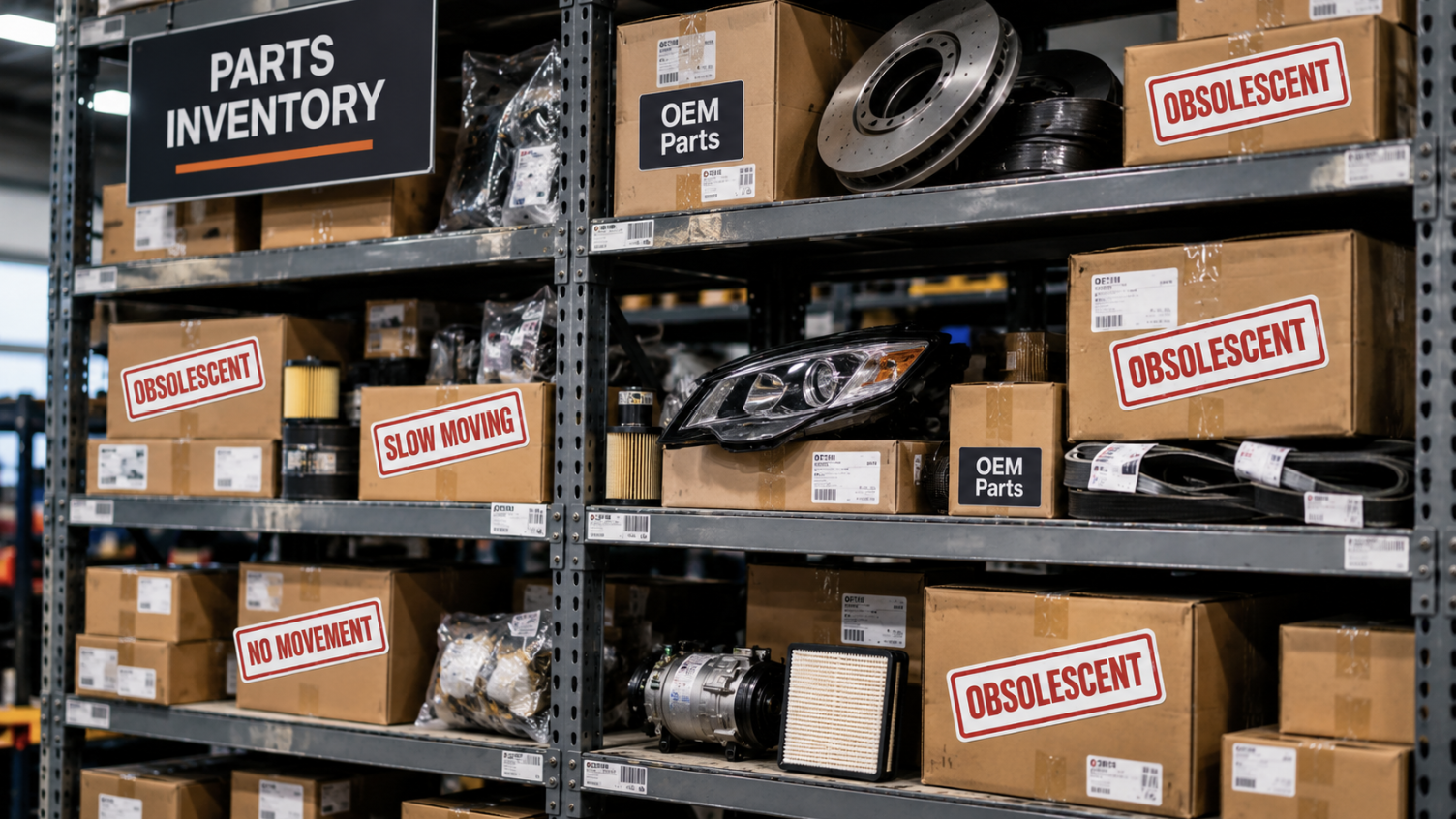
Run the math on your own shelves before deciding this doesn't apply to you. Take whatever dollar figure your last physical inventory flagged as slow-moving or obsolete and ask how much of it would have still qualified for a vendor return if someone had caught it three months earlier. That difference, not the total obsolescence number itself, but the recoverable portion that timing alone determines, is usually the more useful number to know, because it's the one a monthly review actually controls.
Why This Rarely Gets the Attention It Costs
Across the industry, parts inventory tends to sit lower on the leadership dashboard than customer-facing numbers like CSI or show rate, and it's easy to understand why: nobody complains about a part quietly aging on a shelf the way a guest complains about a late repair. The cost is real, but it's invisible until an annual inventory or an audit forces it into view, usually as a number nobody expected.
That invisibility is the actual danger, not carelessness.
A department can be doing everything right on the customer-facing side, strong FRFT, strong MPI view rate, a tight guest journey, and still be quietly bleeding margin through a parts shelf nobody's reviewed since the last physical count. The two problems don't show up in the same meeting, so they rarely get connected.
They're more connected than they look. Capital tied up in dead stock is capital that isn't available for the parts a store actually needs on hand to hit its First-Time-Fix target. A department that's slow to clear obsolete inventory is often, without realizing it, also the department reordering the same fast-moving part for the third time this month because the budget that should have covered it is locked up in parts nobody's going to sell.
What This Actually Looks Like in Practice
None of this requires a new department or a new hire. It requires three habits, run on a schedule instead of whenever someone happens to notice:
A daily SOP aging report, reviewed by someone specific, not just generated and filed.
A monthly obsolescence review, with a clear rule for what triggers a return-to-vendor request versus a write-off.
A deposit policy that's actually enforced at the counter, every time, not treated as negotiable when a guest pushes back.
None of these are complicated. What they require is consistency, the same review, on the same cadence, whether or not anything looks urgent that week. That's usually the actual gap: not a lack of knowledge about what to check, but a lack of discipline about checking it when nothing seems wrong.
Return windows also aren't uniform, which is exactly why a monthly cadence beats an annual one. Different manufacturers and vendors set different eligibility periods for returns, and some are considerably shorter than a store's habitual once-a-year inventory cycle. A part that would have qualified for a full return in month two can be fully expired by the time an annual count ever looks at it. The review has to run faster than the slowest return window in the building, not slower than the fastest one.

Pull the Numbers
If you're a parts advisor or counter person, the aging report is worth a look before it becomes someone else's question, a special order sitting past 72 hours unclaimed is worth a call today, not next week. If you're a fixed ops director or GM, this is worth pulling directly: your current SOP aging report, and your obsolete inventory dollar total against what was written off versus returned in the last twelve months.
If either number is a surprise, that's not a parts problem. That's a review-cadence problem, and it's been costing margin the entire time nobody was looking. See you on the next one!!
-Steve