Ask most fixed ops departments how they set their pricing, and the honest answer is usually some version of "we set it a while ago, and we adjust it when someone complains." Menu pricing gets built once, maybe revisited once a year, and otherwise runs on autopilot while the market around it keeps moving.
That's not a pricing strategy. It's a pricing decision made once and usually never revisited, and the departments actually competing for share treat pricing the way they treat everything else worth tracking: as a number that gets measured on a cadence, not set and forgotten.
The Quarterly Audit Most Departments Skip
Every service drive competes against three different kinds of shops, and most departments can only describe one of them in any detail.
Same-brand competitors are the obvious one, the other franchise stores selling the same badge. But the real competition for customer-pay work is often the other two: independent repair shops, and the tire chains and quick-lube providers picking off maintenance work one oil change at a time. A store that only benchmarks against the dealership across town is missing most of where its customer-pay business is actually leaking.
A real competitive audit, run quarterly, tracks the same handful of things across all three categories: labor rates, menu pricing on the high-frequency items (oil, brakes, tires), how service packages are bundled, and what promotions are currently running. Some of that's a phone call. Some of it is a market-pricing platform built for exactly this. Either way, the point isn't to chase the lowest number in town, it's to know where you actually sit before you decide where you want to sit.
Independents and quick-lube chains tend to get underestimated in this exercise, because they don't feel like real competition to a dealership advisor who's used to comparing against the store across town. But an aging-vehicle owner deciding where to get an oil change or a brake job isn't weighing dealerships against each other, they're weighing the dealership against whatever's fastest and cheapest nearby. If that comparison hasn't been checked in a quarter, the pricing decision is being made blind to the competitor who's actually winning that customer.
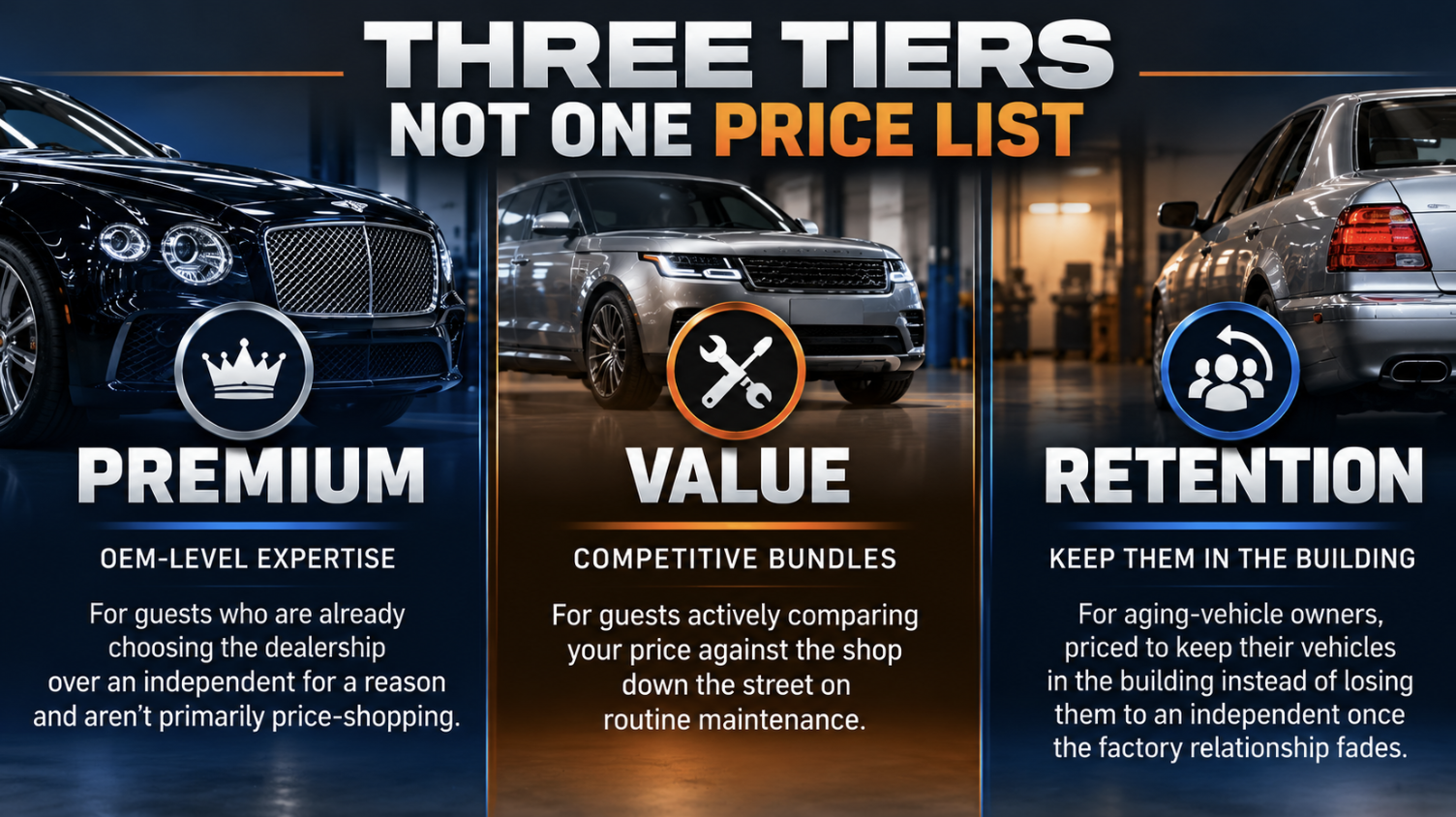
Three Tiers, Not One Price List
A single menu price for a single service misses the fact that not every customer is shopping for the same thing and pricing everyone the same way leaves money on both ends.
A tiered approach fixes that:
Premium, priced on OEM-level expertise, for guests who are already choosing the dealership over an independent for a reason and aren't primarily price-shopping.
Value, built as competitive bundles, for guests actively comparing your price against the shop down the street on routine maintenance.
Retention, priced to keep aging vehicles in the building instead of losing them to an independent once the factory relationship fades.
Running one flat price list across all three of those situations means overcharging the price-sensitive bundle shopper, undercharging the guest who'd have paid for expertise regardless, and giving the aging-vehicle owner no specific reason to stay instead of defecting to whichever independent shop is closest to home.
A single menu price for a single service misses the fact that not every customer is shopping for the same thing.
Menus Built Around the Vehicle's Age, Not Just the Service
The tiers above line up with something most departments already track without connecting the two: where a vehicle sits in its ownership lifecycle.
A vehicle in its first few years, still under warranty, is a different conversation than one at five to seven years, transitioning out of factory coverage, which is a different conversation again from one at eight-plus years, where the real competition is a customer deciding fixed ops isn't worth the drive anymore. Segment-based menus meet each of those conversations where it actually is, warranty-era maintenance for the newest segment, value bundles for the transition segment, budget-conscious repair options for the highest-risk segment, instead of running one generic menu at every vehicle regardless of what stage it's actually in.
None of this works if it only exists as a concept in the service manager's head. It has to show up as an actual menu, digital and printed, so it's consistent whether the guest is looking at a screen or a page, and it has to come with scripting for every single item on it. An advisor improvising an explanation for a service item sounds different every time they say it, and inconsistency reads as uncertainty to a guest deciding whether to say yes.
Sequencing the Build
None of this has to happen at once, and trying to launch all of it in the same month is how a good idea turns into a half-finished one.
Start with the audit. Before touching a single price, spend a month getting an honest read on all three types of competition, same-brand, independent, and quick-lube/tire chain. You can't build tiers around a market position you haven't actually measured.
Build the three tiers next. Once you know where you sit, decide deliberately which guests you're pricing for Premium, Value, and Retention, instead of discovering the answer by accident every time a guest pushes back at the counter.
Segment the menus last. This is the step that requires the most coordination, digital and printed versions, scripting for every line item, advisor training on when to use which menu, so it should come after the pricing logic underneath it is already settled, not before.
Departments that try to do all three in the same week usually end up with a menu that looks segmented on paper but isn't backed by any actual pricing logic, because nobody finished the audit that was supposed to inform it.
Pricing by Design, Not by Reaction
The departments that treat this as an actual strategy aren't guessing at what the market will bear, and they aren't matching whatever the shop down the street posted last week. They know their competitive position because they checked it, on a schedule. They know which of three tiers a given guest actually falls into. And they've built the menu, and the script, to match.
The difference between that and "we set it a while ago and adjust when someone complains" isn't sophistication. It's whether pricing gets treated as a system worth building, or a decision made once and left alone.
If you're an advisor, this is why the script for each menu item matters as much as the price on it, it's the difference between a guest who understands what they're paying for and one who's just hoping it's fair. If you're a fixed ops director or GM, this is worth an honest look this quarter: when did your pricing last get audited against all three types of competition, and does your menu actually differentiate by vehicle segment, or is it one price list pretending to serve three different guests? See you on the next one.
-Steve