The Complete Guide to Handling Service Advisor Objections
Welcome back. We opened with the four-pillar KPI Command Center, then spent last edition on the Twenty Questions behind a strong 1:1. This edition moves into a different piece of the system entirely: how advisors actually convert objections instead of losing to them.
Every advisor hears the same four objections, in some form, multiple times a day: Price. Time. Trust. Convenience.
Most get trained to argue their way past all four in the moment. That's the wrong instinct. Each objection has a different root cause, and each needs a different response, not a better argument, a better process.
Here's the part most sales training, in fixed ops and in sales generally, never covers: it stops at the first two. Price and Time get all the attention, because they're the objections customers say out loud. Trust and Convenience rarely get voiced directly, so they get treated as minor or skipped entirely. That's a costly assumption. A customer who doesn't trust the recommendation, or who's fighting friction instead of a number, will decline just as often as one who says the price is too high, they just won't tell you that's the actual reason.
If your team can only handle Price and Time, you're only equipped for half the objections walking through the door.
Here's the complete framework, objection by objection, plus the math that tells you where to spend your energy after the conversation ends.
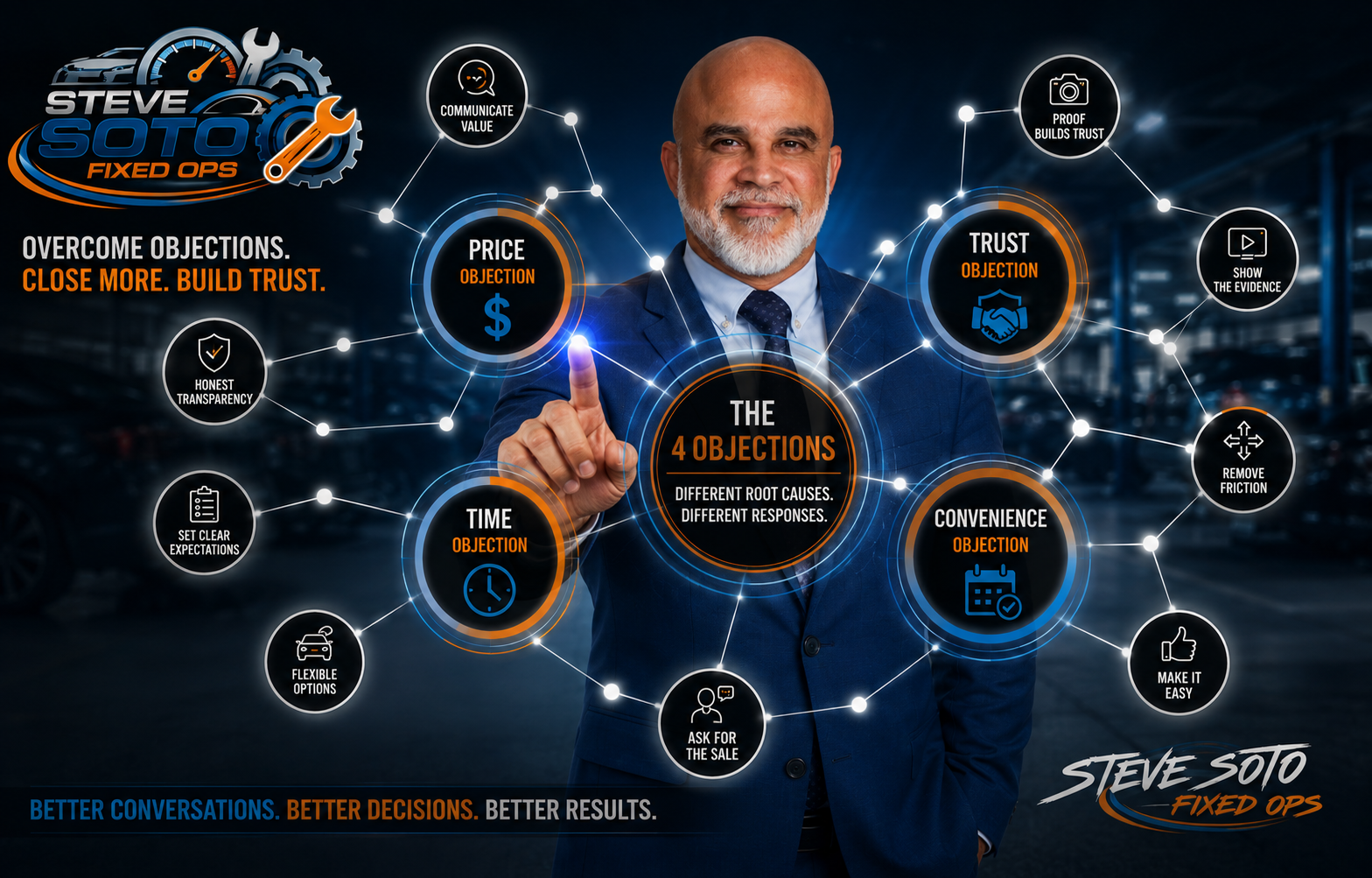
Every advisor hears the same four objections, in some form, multiple times a day: Price. Time. Trust. Convenience.
The Price Objection
"I wasn't expecting this." "That seems really high." "I can't afford that right now."
The price objection is almost never actually about price. It's about timing, value, and trust, stacked together. Treat it like a math problem, reach straight for a discount, and you lose both the sale and your margin in the same conversation. Treat it like the trust and timing issue it actually is, and it becomes a real conversation instead of a standoff.
The playbook:
Anchor value before revealing the number. Explain what the repair addresses and why, before the price ever comes up, not after.
Use honest, risk-based language, never manufactured urgency. Customers can smell manufactured urgency instantly, and it destroys trust permanently once caught.
Give a phased off-ramp. Separate what's safety-critical today from what can reasonably wait 30 days, instead of forcing an all-or-nothing decision.
Introduce payment flexibility early, not as a last resort pulled out only after the customer has already said no.
If your advisors reach for a discount every time they hear this objection, that's not a pricing problem. It's a training gap, the fix is a better explanation of value, delivered before the customer has to ask for one.

It's about timing, value, and trust, stacked together.
The Time Objection
"I don't have time for this today."
The root cause most people miss: this usually isn't about a genuine lack of time. It's about uncertainty. A customer who knows exactly what to expect, how long, what happens if it runs long, what their options are, will wait far longer and far more patiently than a customer with no idea what's happening to the rest of their day.
The playbook:
Set the time expectation before the customer asks, with a specific number, not a vague range
Confirm transportation, shuttle, loaner, ride share, proactively, not reactively
Offer flexible scheduling options the customer may not know exist, like early drop-off or after-hours pickup
If the full job genuinely doesn't fit today, say so plainly and phase the work honestly instead of overpromising
Customers can handle the truth. They cannot handle surprises. A wrong estimate that's optimistic costs you trust permanently, even when the repair itself is perfect.
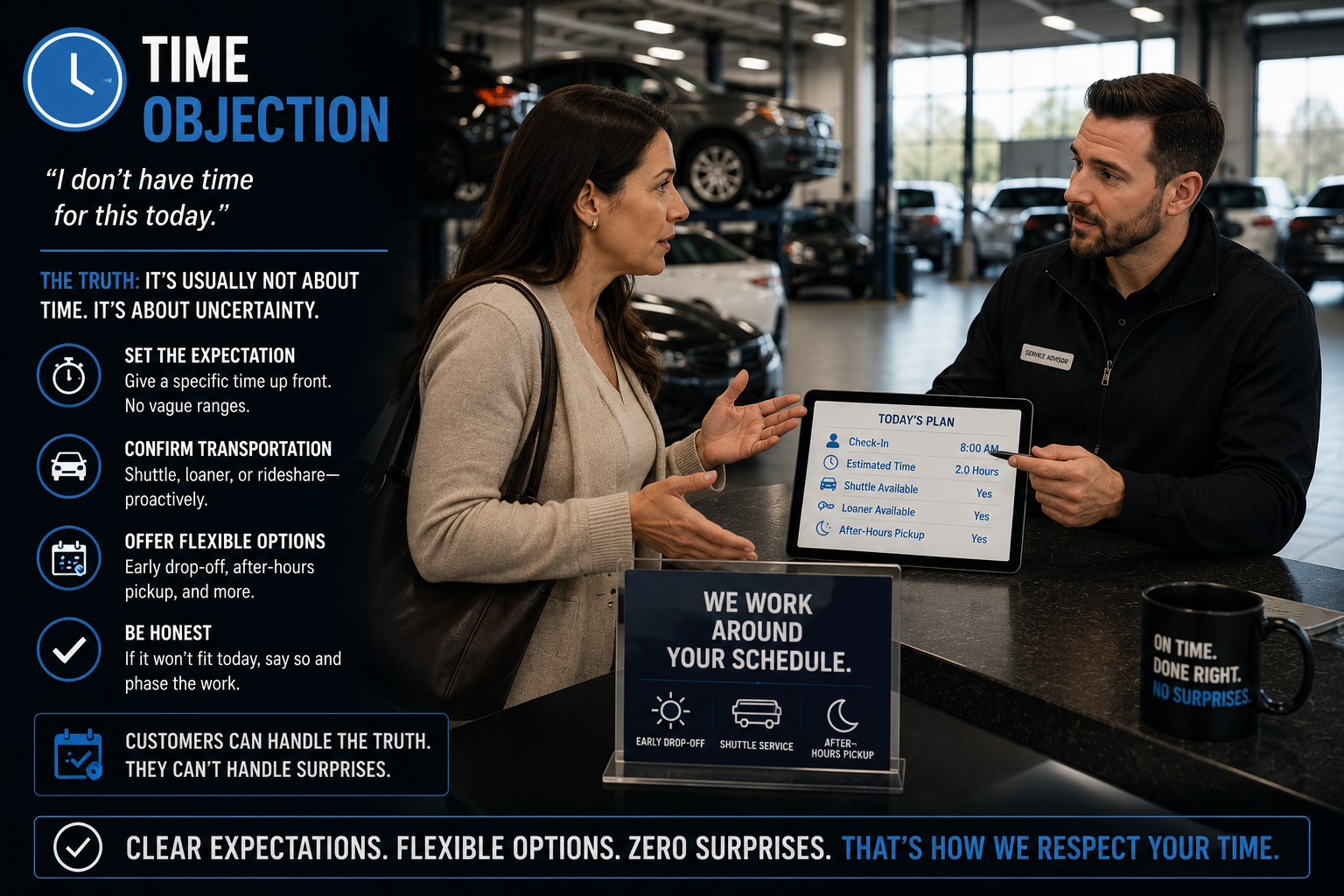
Customers can handle the truth. They cannot handle surprises.
The Trust Objection
"How do I know I really need this?" "I've been burned before at another shop."
This is the hardest objection to overcome with words, because words are exactly what damaged the trust in the first place, usually somewhere else entirely, sometimes years before this customer ever walked into your building.
I went a little long on this one, but for me it is truly one of the biggest and hardest objection in our industry.
The philosophy: stop trying to win trust with better words. Win it with proof. Photos, video, manufacturer specs pulled up on the spot, and physically inviting the customer to see the issue themselves instead of describing it across the counter. The single most effective tool for this objection isn't a script, it's a timestamped photo specific to their car, narrated by the advisor, not just handed over silently.
But attachment isn't the finish line. A technician can shoot a photo and record a video for every single car, and none of it moves the trust needle if the guest never actually opens it. Completion and engagement are two different metrics, the same distinction that matters everywhere else in this business. What actually overcomes the trust objection is proof the guest saw it: MPI open rate and video view rate, not just whether the media exists somewhere in the system.
Track that, and something else opens up. Once you know who actually watched and who didn't, the follow-up call stops being generic, "just checking in" and becomes specific: a reference to the exact thing they saw on video. That specificity is what closes declined work weeks later. It also changes how technicians see their own effort. When a tech knows their video got watched and turned into approved work, the extra thirty seconds spent explaining a worn belt stops feeling like busywork and starts feeling like the reason the job got sold.
Appointment show rate belongs in this conversation too. A guest who trusts what they saw is a guest who shows up for the follow-up appointment instead of quietly letting it slip. If your show rate is soft on declined work you've already photographed and explained, that's a trust gap showing up downstream, not a scheduling problem.
Leadership action item: don't stop at MPI photo and video attachment rate by technician. Layer in open rate and view rate, and coach to those numbers specifically. Attachment tells you the work got documented. Open rate and view rate tell you whether it actually did anything.
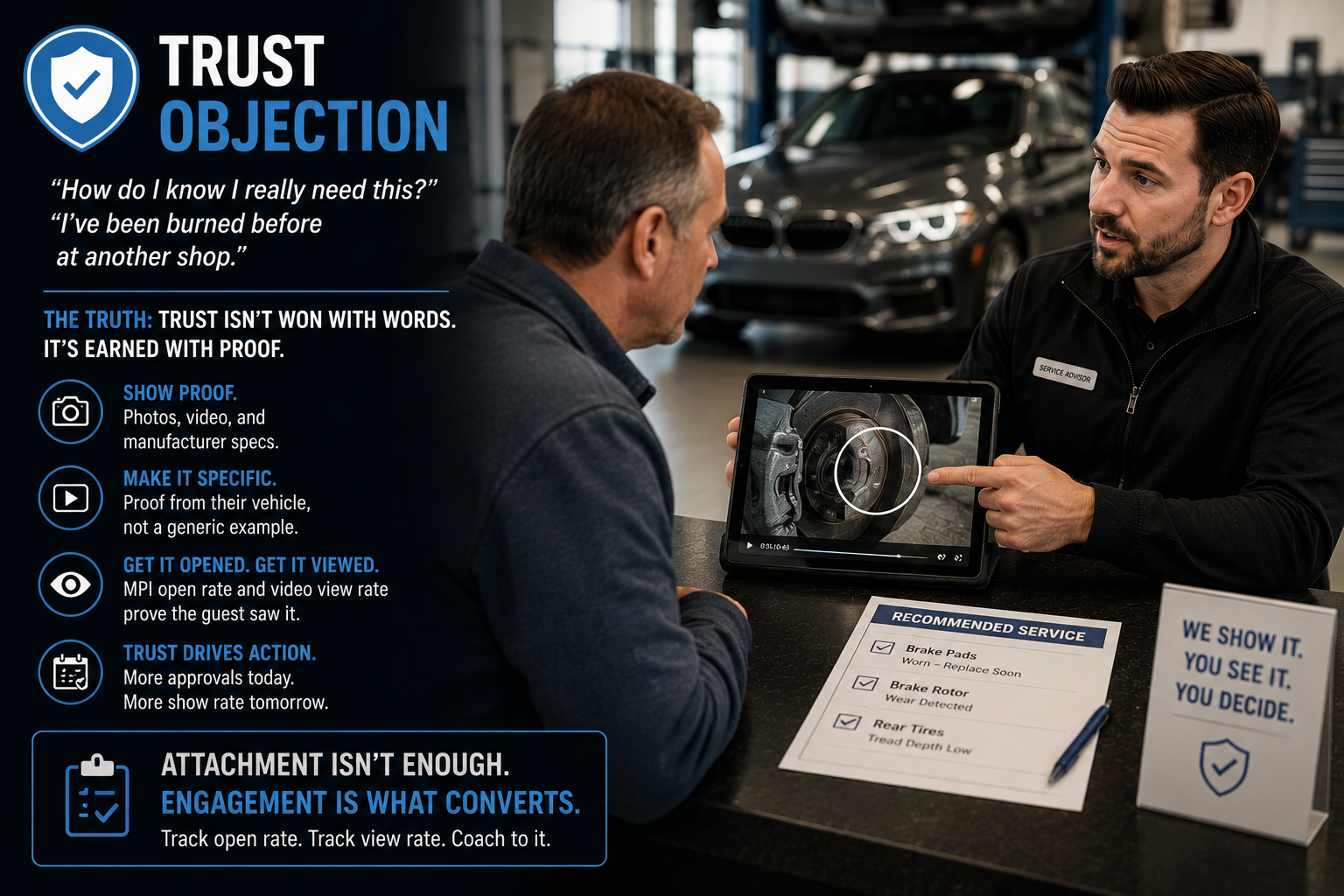
Win it with proof. Photos, video, manufacturer specs pulled up on the spot.
The Convenience Objection
"It just doesn't fit my life right now."
This sounds like a scheduling problem. It's almost always a friction problem, too many steps, too few options, no clear next move offered. The formula I train on every recommendation, no exceptions: Educate. Show. Offer. Ask.
Educate — explain the why, not just the what
Show — visual proof, see-for-yourself instead of trust-me, video MPI
Offer — something concrete that removes a barrier: a payment option, a specific next appointment time
Ask — for the sale, or the appointment, every single time, No excuses, no exceptions
The costliest mistake in this whole framework happens right here: advisors who nail the first three steps beautifully and then let the customer walk out without ever actually asking. You can do everything right for four steps and still lose the sale by skipping the fifth.
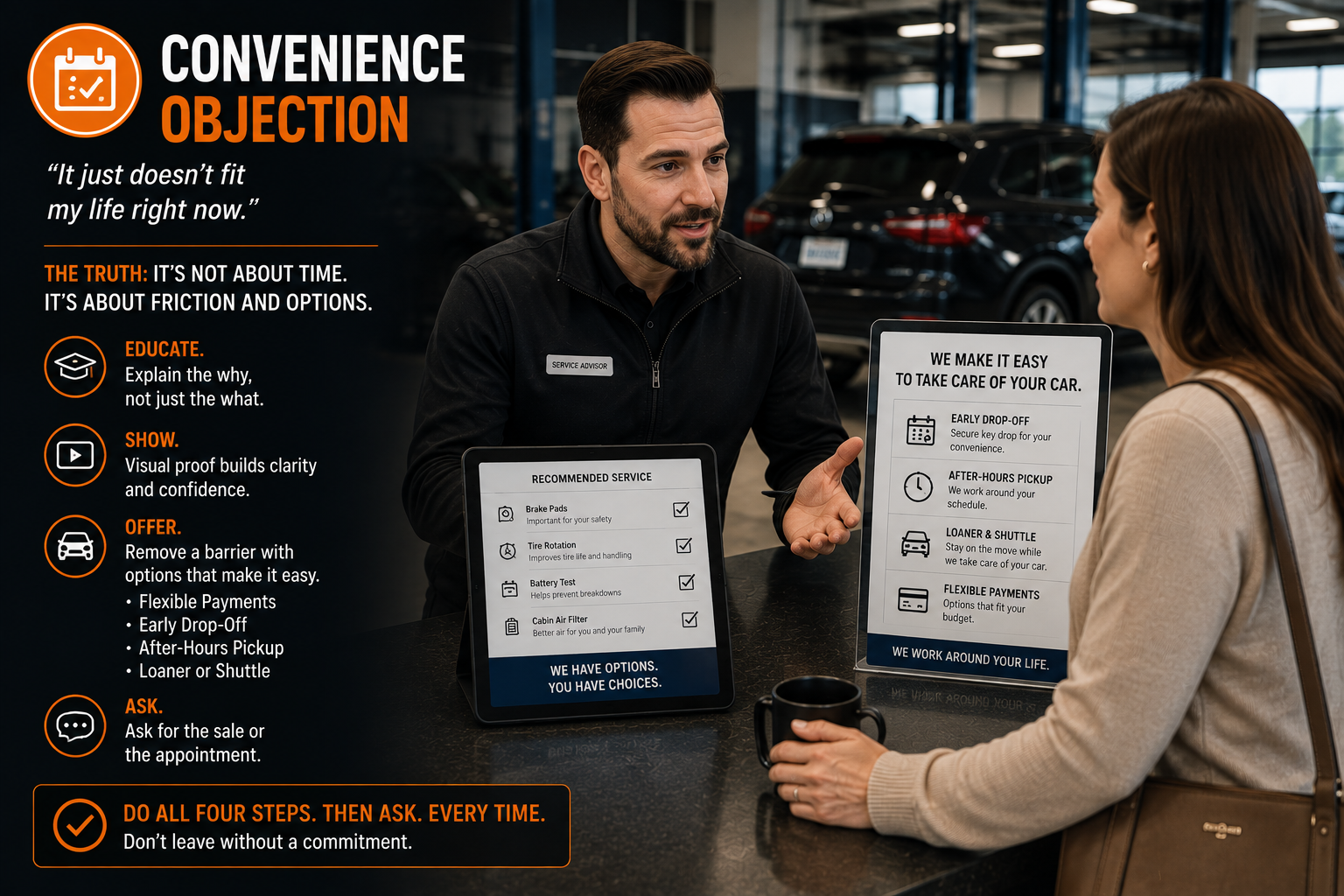
Educate. Show. Offer. Ask
The Theory of Thirds: Where to Spend Your Energy After the "No"
A "no" today doesn't mean no forever, and here's the math that should change how every advisor thinks about a declined recommendation.
Roughly a third of customers are ready to say yes right now, with minimal persuasion needed. These are the ones who trust the diagnosis on sight, they don't need convincing, just permission to say yes. If your team is losing this third, it's not a persuasion problem, it's a presentation problem: something in how the recommendation was delivered created hesitation where none should exist.
A third need the why. Present the same recommendation, and this group asks a real question, wants to see the part, wants the risk explained in plain terms. Handle this group correctly, and they convert. Rush past them the way you'd handle the first third, and you'll lose people who were genuinely persuadable.
And a third are going to shop around no matter what's said, because their decision was never really about the pitch. Maybe there's a shop across town they trust from years back. Maybe the number is genuinely outside their capacity this week, and no explanation changes that. Chasing this group hard rarely moves them, and it burns advisor energy that's better spent elsewhere.
The mistake most advisors make: spending nearly all their closing energy on that last third, the ones who were never converting today, regardless of skill, while the middle third, the ones who'd say yes with the right explanation, walk out completely untouched and unfollowed-up-with. That middle third is the actual growth lever in this whole framework, and it's the one getting ignored in almost every store.
The fix is a deliberate follow-up cadence built specifically for that middle third, not a single afterthought call:
Day 3-5: A short text or call confirming they received the MPI findings and offering to answer questions. Low pressure, just keeping the door open.
Day 14: A follow-up referencing the actual photo or video from their MPI, not a generic "checking in." If your view rate data shows this guest actually watched it, lead with that, "I saw you had a chance to look at the belt video" opens a completely different conversation than a cold restart.
Day 30-45: A direct call to action: schedule the appointment now, tied to a clear reason, the season, the mileage, the original finding.
That kind of layered cadence, applied consistently to the middle third and only the middle third, is what separates a department that treats a decline as a dead end from one that treats it as the start of a sequence. The first and last groups take care of themselves either way, the middle third is where a real follow-up system earns its keep.
Putting It Together
None of these four objections get solved by a better script in the moment. Price gets solved by leading with value before the number. Time gets solved by removing uncertainty before it forms. Trust gets solved by proof the guest actually saw, not persuasion. Convenience gets solved by actually asking. And what happens after the "no" gets solved by knowing exactly which third of your customers is worth calling back.
Train advisors on this as one connected system, not four disconnected tips, and declined work stops being the end of the story.
Next edition, we'll get into how I lead a turnaround, the belief that has to change first, what the first day should actually look like, and how the first 90 days should be sequenced. See you then.
-Steve
Galatians 6:9